

Sash Thoughts
Minimalism vs. Indian Culture: Why We Celebrate Abundance, Not Emptiness
Minimalism, in its westernized sense, often doesn't align naturally with the rich, layered, vibrant fabric of Indian culture.
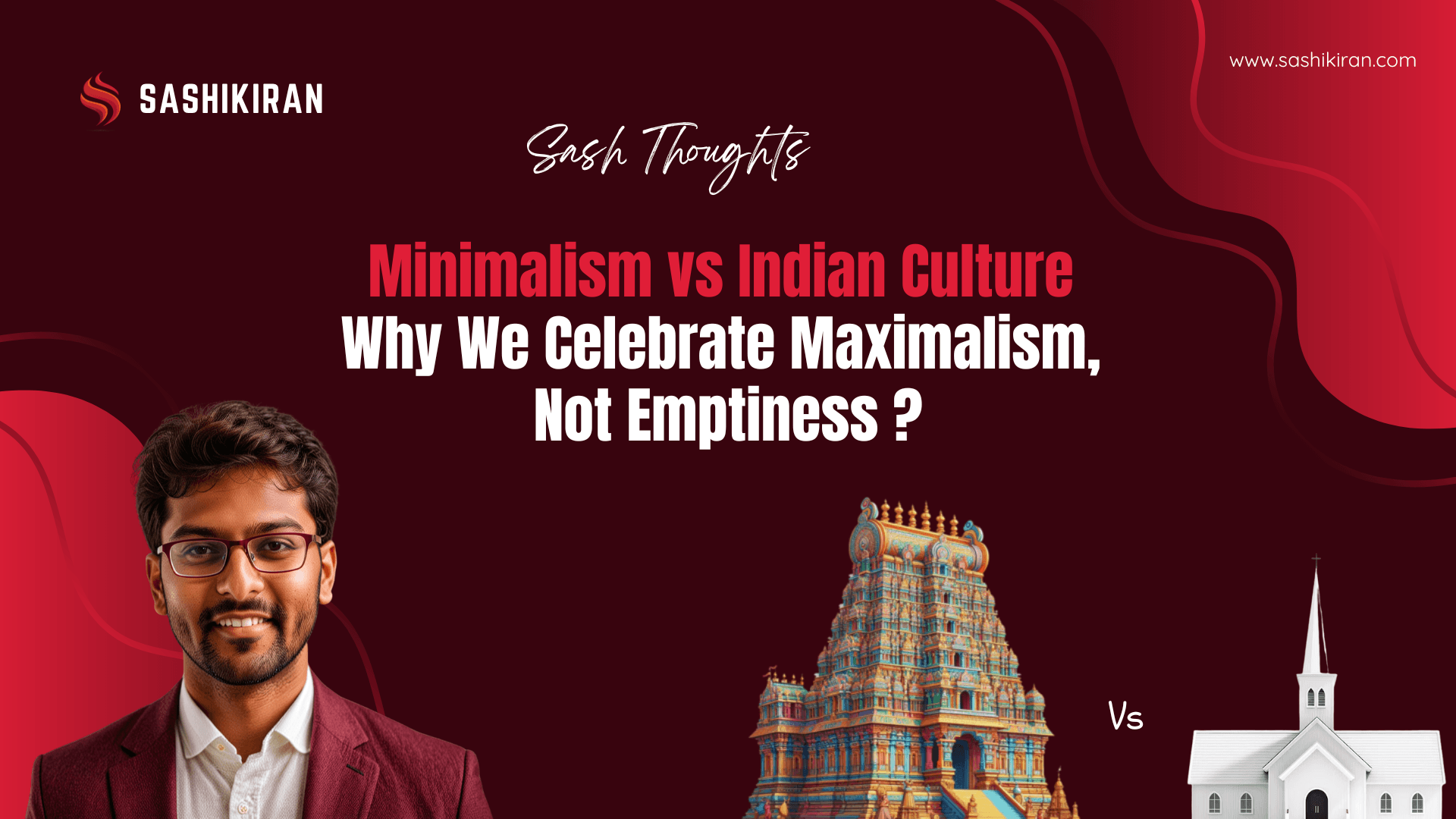
Minimalism vs. Indian Culture: Why We Celebrate Abundance, Not Emptiness ?
When you think of minimalism, you might imagine muted colors, empty spaces, and the philosophy of "less is more."
But when you walk into a typical Indian home or experience Indian festivals, weddings, or shopping streets, you realize — India celebrates abundance, not restraint.
Minimalism, in its westernized sense, often doesn't align naturally with the rich, layered, vibrant fabric of Indian culture.
Here's why.
🌸 1. Indian Culture Celebrates Abundance
From our festivals to marriages to daily rituals, grandeur is a form of love.
Weddings are week-long events with multiple ceremonies, extravagant decor, colorful outfits, and hundreds — sometimes thousands — of guests.
Festivals like Diwali, Navratri, Durga Puja are celebrated with lights, colors, food, gifts, gatherings, and elaborate decorations.
Even in daily life, an Indian household often overflows with kitchen spices, clothes, souvenirs, heirlooms, religious items, and family mementos.
Example:
During Diwali, homes aren't stripped down for simplicity — they're filled with lights, rangolis, sweets, new clothes, and gifts.
It's not about "having less" — it's about sharing more.
🏠 2. Our Homes Tell Stories — Not Display Minimalism
In India, a living room isn’t just a "living room."
It’s a museum of memories.
You’ll often find:
Shelves filled with family photos across generations
Cabinets displaying artifacts, awards, religious idols
Walls adorned with bright paintings or intricate tapestries
Furniture that has been passed down, not discarded
The philosophy isn’t about clearing space — it’s about honoring every piece of the journey.
Example:
In a traditional home in Jaipur or Chennai, you'll find vibrant wall colors, ornate furniture, and crafts from different states — all layered with meaning.
🍛 3. Food Culture: Variety Over Simplicity
Indian meals are another clear reflection: more is better.
A simple lunch can have 4–5 dishes: dal, sabzi, rice, roti, pickle, papad.
A South Indian wedding feast (Sadya) can have over 20 items served on a banana leaf.
Spices aren't reduced to salt and pepper — we use layers of masalas, each adding complexity.
Example:
No one at a Punjabi wedding is thinking, “Let’s keep the food menu minimal.” Instead, there’s a buffet of chaats, tikkas, biryanis, desserts, and more!
🛍️ 4. Emotional Attachment to Things
In India, things carry stories.
The old saree tucked away reminds a mother of her wedding.
A brass diya (lamp) passed from grandmother to mother lights every Diwali.
The cracked cricket bat isn't junk — it’s a childhood memory.
Decluttering in a traditional Indian home isn’t about throwing things away easily — it's a deeply emotional process.
Example:
You’ll rarely see an Indian home that casually "edits" old photo albums or wedding cards — they are preserved, treasured, and passed on.
🧠 5. Societal and Economic Layers
For many Indians, especially from older generations:
Owning more meant security and success.
Savings meant having goods, gold, assets — not empty spaces.
Hospitality meant being able to provide more to guests, not less.
Minimalism, which sometimes implies "having less intentionally," can feel alien because in India, having more meant protecting your family’s future.
🎯 So, Are Indians Anti-Minimalist?
Not exactly.
Modern Indian minimalism is evolving — especially among the urban, younger generations.
But it looks different:
It’s about meaningful abundance, not sterile minimalism.
It’s about owning things with emotional value, not clutter for the sake of it.
It’s about vibrant spaces curated with love, not empty white walls.
We may embrace simpler living over time, but culturally, India’s heart beats in color, complexity, and connection.
And that's something beautifully unique.
✨ Final Thought
Minimalism asks, "What can I live without?"
Indian culture asks, "What makes life more meaningful to live with?"
Neither is wrong — but they are fundamentally different paths to joy.
Understanding that Indian culture leans toward maximalism — celebrating abundance, stories, and emotional richness — is crucial for designing experiences that resonate. Successful product design isn’t about blindly applying global trends like minimalism; it’s about deeply studying the emotional and cultural landscape first. Frameworks like the 7S Design Framework emphasize this — guiding designers to research deeply (Study), define culturally aligned goals (Specify), and craft emotionally powerful experiences (Solve and Stylize). If we want to design products that Indians truly connect with, we must honor their love for meaning, memory, and abundance. For more structured approaches to culturally intelligent design, exploring the 7S Design Framework can be a great starting point.